
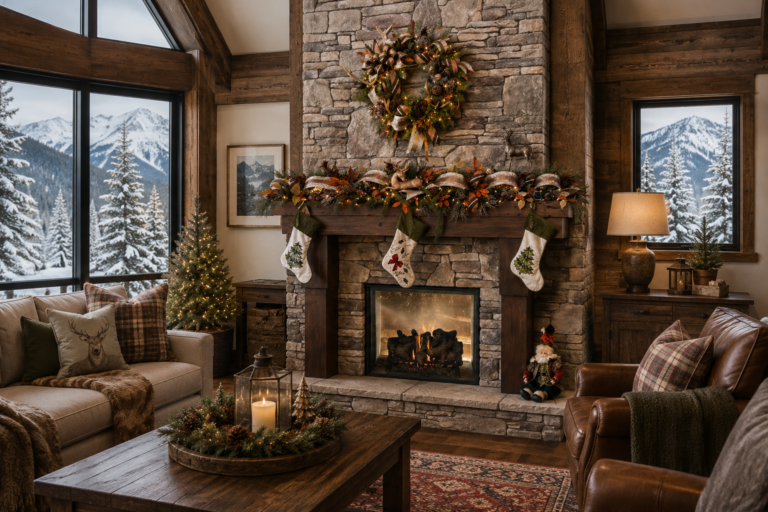
Christmas mantel decorating ideas for mountain homes in Southwest Colorado
One of the things I love most about the holidays is that everyone has their own style.
For some, it’s warm and whimsical. For others it’s a go big or go home approach — where the tree and garland are layered so fully you almost can’t see the greenery beneath. And in mountain homes, there’s often a pull toward something quieter. The simple, grounded beauty of nature brought inside.
There’s no right or wrong. But there is a difference between decorating a mantel and designing one that truly fits the home.
If you’re still exploring what your style might be: → [Find the Holiday Style That Feels Right for Your Mountain Home]
Let the Home Lead
For me, the style of a mantel never starts with the décor. It starts with the home.
What works beautifully in a suburban setting can feel completely out of place in a mountain home. The materials, the scale, the surroundings — all of it influences the direction. A stone fireplace with exposed timber beams asks for something different than a painted mantel in a more traditional space. The home itself is always the first conversation.
From there, the overall design direction shapes every choice. When I’m working within a nature-inspired aesthetic, I move away from anything overly glittered or ornate and gravitate toward elements that feel like they belong — textures, tones, and materials that complement the environment rather than compete with it.
That’s often where understated design begins. Not by doing less — but by choosing differently.
The Foundation Most People Overlook
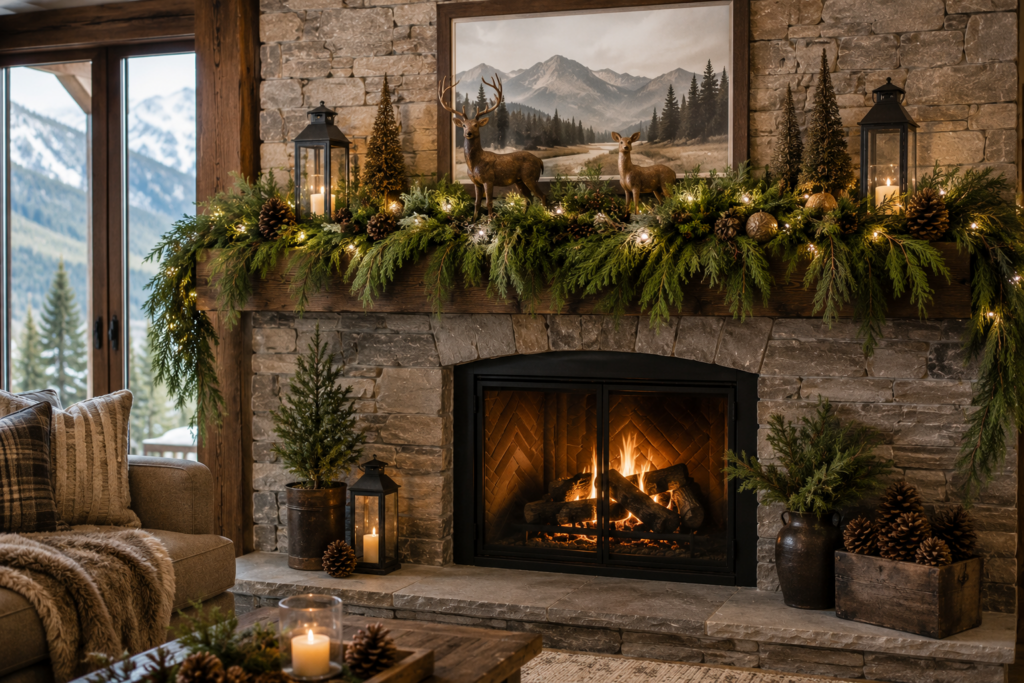
One of the most important factors in creating an understated mantel has nothing to do with ribbon, ornaments, or accents. It’s the base. More specifically — the quality and style of the garland.
There’s a common assumption that a simpler mantel should cost less. If you’re doing less, you can spend less. In reality, the opposite is often true.
When you remove the layers of ribbon, florals, and decorative picks, the greenery becomes the focus. And when that happens, the eye notices everything — the color, the texture, the fullness, even how the branches fall. There’s nowhere to hide. Which means the quality of what you’re working with matters more, not less.
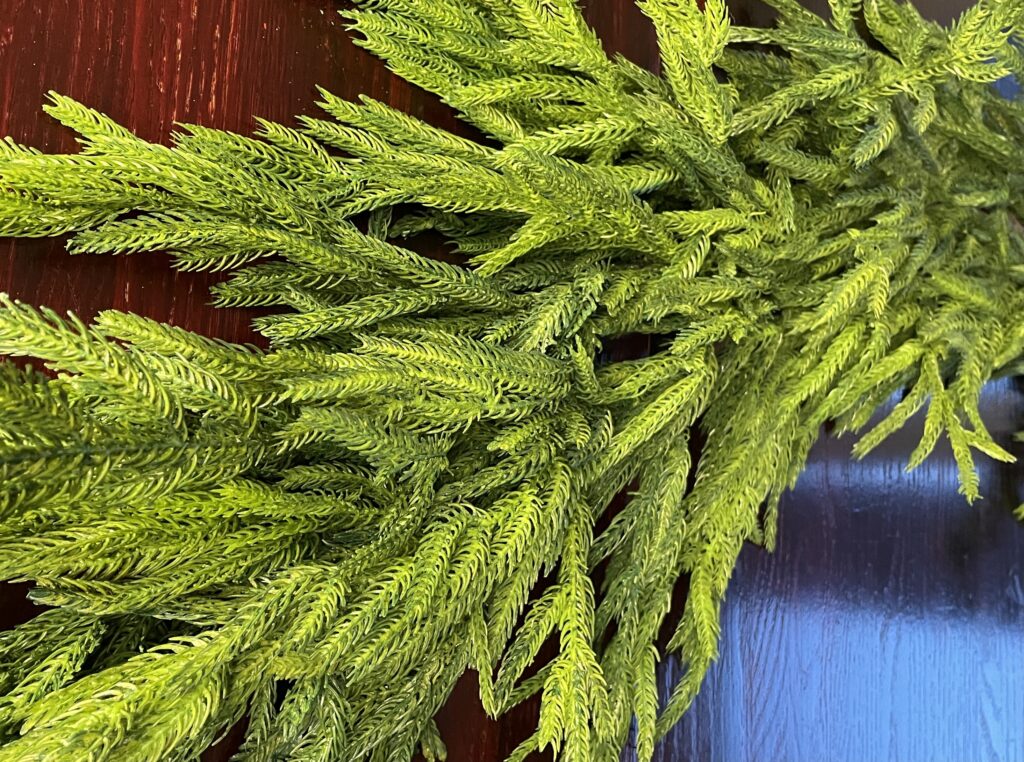
This is why I look specifically for garlands labeled real-touch or real-feel — made using molding techniques that replicate the shape and texture of actual greenery, often modeled on Norfolk pine or cedar. The difference is subtle at first glance and unmistakable in a finished space.
Why the Garland You Buy Online May Disappoint You
You’ve likely seen beautiful garlands advertised online for $20 to $40. I’ll admit I’ve been tempted myself. On screen they can look full, soft, and natural. In person they’re almost always a disappointment — lighter, more plastic, the color slightly off, the branches stiff rather than draping naturally.
What’s often not disclosed is that the image you’re seeing isn’t a single garland. It’s several intertwined to create that full, luxurious look. There’s nothing wrong with layering garlands — I do it myself. But it’s worth understanding what you’re actually getting.
Higher quality garlands — typically $250 to $490 — have a deeper, richer color and a slightly supple feel that allows the branches to move naturally and drape the way real greenery does. In an understated design, that difference is everything.
If you already own garland that doesn’t feel as natural as you’d like, you don’t need to start over. Use what you have as a base layer to build fullness, then add a top layer of higher quality greenery. The variation in color and texture that results is actually more interesting than a single garland alone — and the eye naturally settles on the more realistic elements.
Knowing When to Stop
One of the most overlooked parts of creating an understated mantel is knowing when it’s finished.
Not when there’s no space left — but when adding more would actually take something away.
I don’t approach a mantel by asking what else I can add. I’m asking what the space needs — and just as importantly, what it doesn’t. Sometimes that means removing something beautiful that simply doesn’t serve the overall design. That editing instinct is one of the things that separates a decorated mantel from a designed one.
Fewer, Larger, Better
When creating an understated mantel, the question isn’t how much to include. It’s what to choose — and how many.
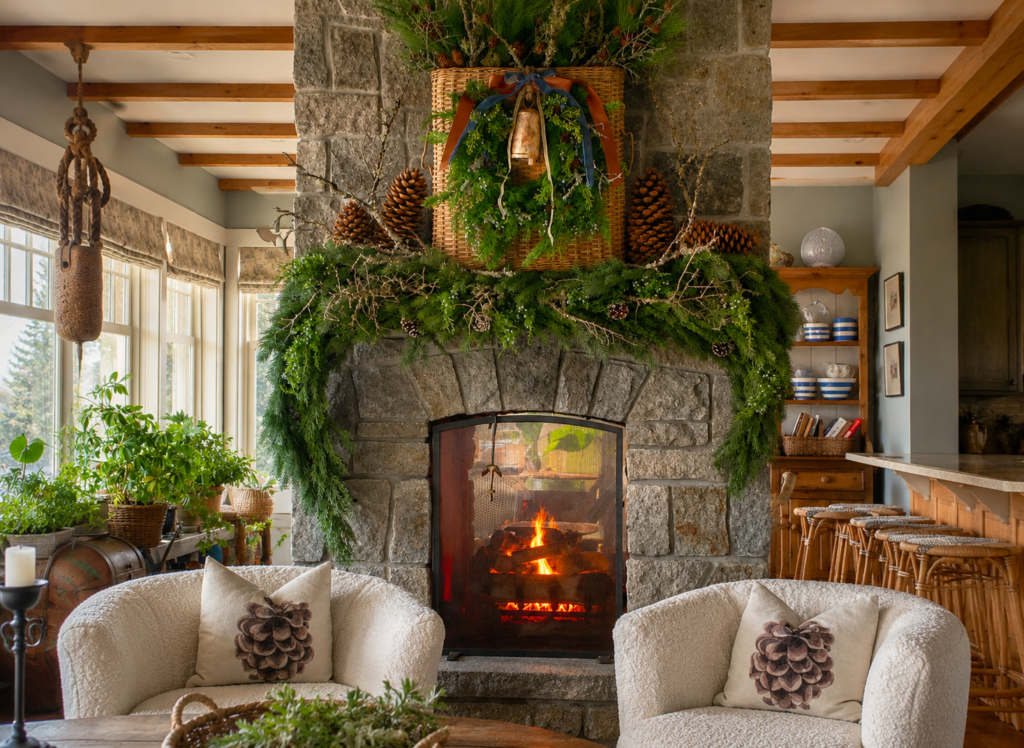
I consistently gravitate toward fewer, larger, better elements rather than many smaller ones. In a mountain home, that might look like oversized pine cones — mixing varieties like long slender sugar pine cones with shorter wider digger pine cones for natural variation. A light coat of polyurethane spray brings out the richness and luster of the wood in a way that’s subtle but immediately noticeable.
Antlers are another favorite. Real sheds are always my first choice when they’re available. High quality resin options can work beautifully as well — and even less expensive versions can be elevated significantly. The shape is often there; it’s the color that falls flat. With the right finishes — including paints or products like Rub & Buff — they can feel far more refined than their price tag suggests.
Trusting Your Eye
In the end, knowing when a mantel is finished comes down to knowing yourself.
What draws you in? What feels like too much? If you’re not sure, sit with it. Look at the mantel in different light — morning, evening, with the fire going and without. Something will tell you what it needs. Don’t be afraid to move things, remove them, or make one small adjustment that brings everything into balance. Often it’s that single thoughtful change — one element added or taken away — that makes the whole design settle.
A Final Thought
At its best, an understated mantel doesn’t feel decorated. It feels like it belongs — within the home, within the season, and within the way you want the space to feel.
There’s a quiet confidence in that kind of design. Nothing competing. Nothing overdone. Just a sense of balance that’s there the moment you walk into the room.
When your time at home is limited, that feeling matters more than most people expect. And when it’s handled well, it’s one of the details that stays with you long after the season is over.
If you’re drawn to a more thoughtful, refined approach to holiday decorating and would rather have it handled than take it on yourself, I’d love to hear about your home.
© 2026 Durango Holiday Home LLC. All rights reserved.