

What we learned about pack rats, mice, and the creatures who were here long before we were
I used to think rodent problems were for other people.
You know the ones. Hoarders. People with crumbs on every surface. Certainly not neat freaks like me, in a beautifully built custom home in the mountains of Colorado.
Boy, was I wrong. Spectacularly, repeatedly, and occasionally hysterically wrong.
This is that story. Actually — it’s three stories. Because apparently once wasn’t enough of a lesson.

Act One: The Smoking Rat
It was late September, our first real chance to host guests at the new mountain home. My sister Jeannie and her husband had driven down from Dillon for a long weekend, and we were beyond excited to share the place with them. The plan was simple and perfect: snacks, cocktails, a roaring fire in the giant outdoor fireplace, and the kind of afternoon that reminds you why you bought a mountain home in the first place.
And it was perfect. The fire crackled. The elk in a nearby meadow bugled for a girlfriend, as they do in late September. We sat there in the kind of stillness that makes everything feel right.
And then Jeannie screamed.
Not a small scream. A top-of-her-lungs, point-at-the-fireplace scream.
Because there — launching itself from the burning firebox like a tiny, smoking missile — was a rat. Flying across the patio. Fleeing what had apparently been his home.
It was an odd mix of disgusting and hysterical.
Here’s what we learned: pack rats love tightly enclosed spaces. The realtor who staged the home had placed a large metal grate with massive logs in the outdoor fireplace — charming to prospective buyers, irresistible to pack rats. For months before we ever moved in, he had been industriously stuffing sticks, leaves, and whatever else he could find into every gap. Building his dream home, too.
We felt a little bad about the eviction. But not that bad.
We cleared out the nest and removed the grate entirely. That helped considerably. We also use a deterrent spray around the fireplace area, which helps more. But honestly — if we’ve been away for a stretch — we still find clues upon our return. Pack rats are persistent. You manage them. You don’t entirely eliminate them.
Act Two: The Engine Nest
A few days later, Randy went to check the oil in his F-150.
It appears our fireplace rat had found a new home — under the hood of the truck, parked in the driveway overnight. One night. The ambition alone was pretty impressive.
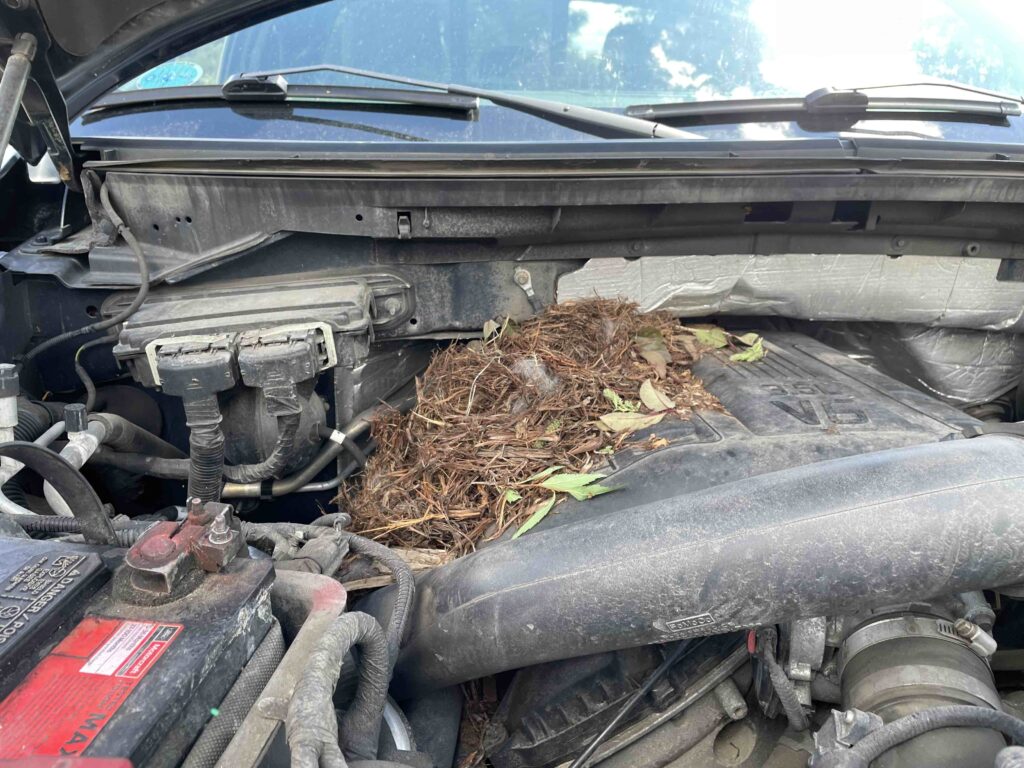
Thankfully, the wires were untouched. We got lucky. Rodents chewing through wiring is not an inexpensive problem, and in a hot engine, a dry nest is a fire waiting to happen.
The lesson was clear: if you have a garage, use it. If you don’t, make a habit of checking under the hood — especially before a long trip when an engine running hot over miles of mountain highway could ignite whatever’s been tucked in there.
Act Three: The Security Camera
By fall of 2024, we thought we had things reasonably under control.
Then our security camera sent a motion alert. We were in Michigan. I will not pretend my mind didn’t go immediately to men in ski masks carrying off our belongings. It did. We pulled up the footage bracing for the worst.
What we saw instead was a faint ruffling of garland dust on the mantel — and a quick flick of something that looked very much like a tail.
We called our neighbor Chris to investigate the next morning. His report was not encouraging. Ground zero was the pantry, which he described as looking like the aftermath of an Animal House party. Randy had left cereal boxes and bags of granola on the shelves — tightly sealed, as any reasonable person would. It didn’t matter. Mice had eaten through everything. And then apparently squirreled it away all over the house — we found cereal in desk drawers, in rooms far from the pantry. They weren’t just hungry. They were meal-prepping, building little stashes in every corner like they were planning for a very long winter.
Now, I am not normally one to wish harm on any of God’s creatures. But I will admit that I secretly hoped the mouse who consumed an entire box of unflavored gelatin died of constipation.

Calling in the Expert (Again)
There was only one call to make: Payden Bell at Rocky Mountain Bird & Pest Solutions. If you’ve read our Woodpecker or Bat editions, you already know Payden. At this point, we’ve considered having his mail delivered here.
Payden walked the interior and exterior and identified every gap, crack, and entry point we’d never thought to look for. Mice can squeeze through openings as small as 3/8 of an inch. Door thresholds. Kitchen cabinets where gas lines rise up from the crawl space. Exterior vents. Once you see it, you can’t unsee it.
He showed us how to line exterior vents with fine mesh screening to close off those entry points. And the advice that stuck most: the best solution is stopping them from getting inside in the first place. Everything else is damage control.
Rocky Mountain Bird & Pest Solutions: 970-769-9906 | www.rockymountainbps.com
Ask for Payden — or you may reach his mom Cyndy, who is equally wonderful.

What We Do Now
We’ve learned a few things the hard way that might save you the trouble.
Everything in our pantry now lives in glass jars, metal cans, or OXO containers. If we owned stock in OXO, we’d be considerably wealthier. Cardboard and plastic bags, no matter how tightly sealed, are not a deterrent — they’re just a minor inconvenience.
We place cotton balls and pads soaked in peppermint oil in strategic spots throughout the house, including inside the trash compactor, which we always leave empty. Mice apparently find peppermint deeply offensive. Given what they did to our pantry, the feeling is mutual.
We’ve also heard that Bounce dryer sheets work as a deterrent. Some people call it a myth. We’ve used them and haven’t had problems since — so we’re keeping them in the rotation.
One thing worth mentioning for fellow pet owners — we have an English Springer Spaniel named Bert, and finding rodent solutions that are safe around dogs has been a priority. If you have pets, it’s worth asking Payden specifically about pet-safe options. It’s not one-size-fits-all.
And if Randy parks outside for any length of time? He checks under the hood. Every time.
A Final Thought
I came to the mountains thinking rodents were someone else’s problem. I know better now.
The truth is, they were here long before we were. They’re resourceful, industrious, and completely unintimidated by a neat freak from Michigan. The best you can do is stay a step ahead, know who to call when you’re not, and find the humor in it. Because there is humor in it. Even the smoking rat — in retrospect — was kind of magnificent.
If you have tricks, tips, or rodent stories of your own, I’d genuinely love to hear them. Email us at info@durangoholidayhome.com. This series exists because we’re all figuring it out together, and the best lessons tend to come from people who’ve already made the mistakes. We’ll happily update this post — or write a whole new one — if you send us something good.
→ Life Lessons of a Durango Homeowner: Woodpecker Edition
→ Life Lessons of a Durango Homeowner: Fire Mitigation Edition
→ Life Lessons of a Durango Homeowner: Bat Edition
© 2026 Durango Holiday Home LLC. All rights reserved.