

What local fire officials want you to know before you plug in the holiday lights
As someone who decorates other people’s homes for the holidays, fire safety is something I think about constantly. I don’t have any personal expertise in fire prevention myself, so I reached out to local fire officials to ask the questions a typical Google search wouldn’t turn up.
Below is what they shared, based on their years of hands-on experience. I’m passing it along because it’s worth hearing directly from people who do this for a living.
Your Biggest Risk Isn’t Always the Tree
I assumed Christmas trees were the biggest culprit behind holiday fires. According to local fire officials, that’s not always the case.
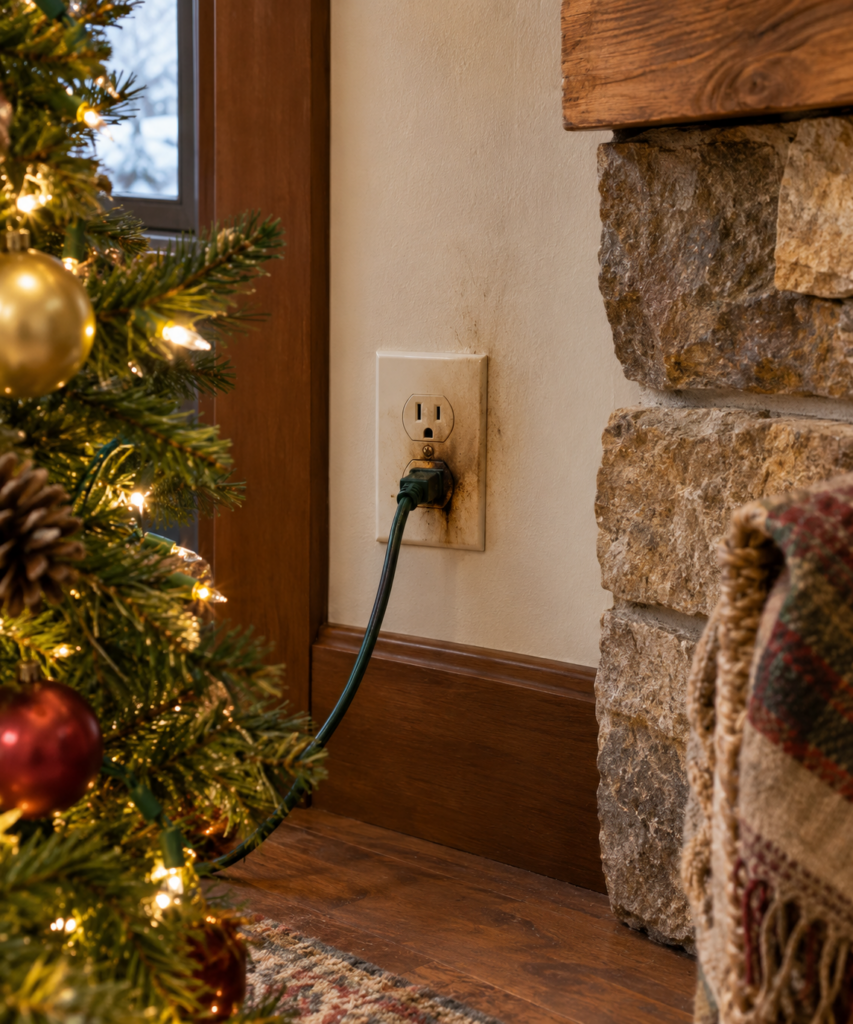
Often, it’s just poor wiring — connectors that aren’t rated for the load, things plugged in that shouldn’t be together, and hot components placed too close to anything combustible. In their experience, trees get the blame because they’re the most visible thing in the room. But wiring is often the actual cause.
That reframed the whole conversation for me. Really, it’s about electricity — and how carelessly most of us treat it during the one season we’re using more of it than any other time of year.
Buy Quality, Skip the Discount Bin
One of the clearest pieces of advice I heard: don’t buy anything electrical from deep discount stores — extension cords, timers, light strands, etc. Electricians say the same thing: the quality simply isn’t there. The suggestion is to stick with more established retailers and brands instead of chasing the lowest price on something that’s going to carry a current through your home for six weeks.
It’s a small upfront difference in price for something you’ll never regret — not an expense, but an investment in the safety of the home you’re decorating.

Fewer Connections, Fewer Risks
This was where it was nice to hear confirmation that I’d already been doing something right.
For many years, live trees were my tree of preference for our Michigan home due to their natural beauty and incredible scent. I always had ours cut just a couple of days before Thanksgiving, since the ones on roadside lots are cut up to two months before that. I watered it daily, sometimes twice. But even with the right care, needles still dried out. More than a mess, live trees cause up to 3x more fires than artificial trees. That’s part of the reason I’ve changed to artificial. That, and the fact that the quality has come a long way, with molded branch tips that look far more lifelike than the old PVC versions. And if I’m honest, as a self-described Christmas “banana,” artificial lets me put a tree up earlier and keep it up longer.
The trees I use now are pre-lit with LED micro-lights, powered through a single pole rather than a dozen strands linked together end to end. The smaller LED bulbs draw less power and run cooler than older incandescent lights, which matters more than people realize. The advice was simple: the fewer connections you have, the better. A tree that comes with its lights built in isn’t just more convenient — it’s genuinely safer than stringing several sets together to get the coverage you want. This is especially true for the Clark Griswolds of the world, like me.
The same logic applies to extension cords. Make sure they’re grounded (three-prong, not two), and avoid connecting two together. Also, don’t use indoor cords outdoors if you can help it. If you can’t avoid it, wrap the connection in something like Saran Wrap to protect it from snow or rain..
A Few More Rules Worth Following
Some of this advice comes from years of firefighting experience. But there’s also a set of well-established, general precautions that any home stylist or electrician would echo — the kind of guidance Martha Stewart’s team recently laid out in a roundup on holiday lighting mistakes. A few of those points are included below.
Running cords through a closed window or door is one to watch. The pressure from the frame can pinch the wire and crack the insulation, creating a hidden short behind a spot you’d never think to check.
Mixing old light strands with new ones is another. An older strand can be more worn than it looks, and pairing it with a newer, brighter LED set — which often draws power differently — can overload the circuit without any obvious warning sign.
Hanging lights with metal hooks or staples is a habit worth breaking, too. Piercing the cord to hang it, even slightly, can create a point where the current arcs or sparks. Plastic clips or adhesive hooks made for string lights do the same job without the risk.
And cords hidden under a rug or wedged behind furniture deserve a second look. They need airflow to stay cool, and a hidden cord is also a hidden fraying cord — you won’t notice a problem until it’s already one.

The Basics: Extinguishers and Alarms
According to local fire officials, one of the most overlooked fundamentals is having working fire extinguishers nearby — preferably more than one. The recommendation is an ABC-rated fire extinguisher, roughly five pounds, with the kitchen and the garage both being good spots.
Know Your Detectors: Smoke Up, CO Down
This one genuinely surprised me. A lot of newer homes mount combination smoke and CO detectors high on vaulted ceilings. It’s a setup local fire officials aren’t fans of, and once they explained why, neither was I.
Smoke rises. So a smoke detector belongs up high, where it can catch danger early. But carbon monoxide is heavier than air. By the time it reaches a detector near an 18-foot ceiling, the room below is already significantly saturated. The recommendation: buy them separately. Mount the CO detector low, closer to where people actually are.
It’s also worth picking one day a year to swap the batteries in every detector in the house, hardwired or not — New Year’s Day is a popular choice. October works well too, since it’s widely recognized as Fire Prevention Month. Or simply use your last visit to the house before decorating season begins. It’s also a good time to shop — many retailers run sales on smoke and CO detectors and fire extinguishers in October, so it’s worth replacing or restocking while things are discounted.
Trust Your Nose
If something smells off, it may be in the wall. That’s not something you can just look at and check. The advice was simple: call 911 immediately. Don’t wait to be sure.
Firefighters carry gas monitors that test for five different types of gas the moment they arrive. If it turns out to be nothing, that’s a good outcome, not a wasted call. Calling early is far less costly, and dangerous than waiting until a fire has already started behind your drywall. At that point, putting it out often means water damage to exactly the gifts, trees, and decorations you were trying to protect in the first place
Watch for the Warning Signs
Local fire officials flagged a few specific things worth watching for. Any discoloration on an outlet or switch faceplate — even a slight graying — is a sign that something is running hotter than it should. It’s worth having an electrician take a look right away.
Older homes carry more of this risk. Homes 50 years old or more were often wired to a different standard than what’s required today. If that wiring has never been inspected or updated, it’s worth having an electrician take a look before loading it up with holiday lighting. This felt especially relevant close to home here in Durango, where some of the most beautiful log homes in this area are also some of the oldest.

Fireplaces and Wood Stoves: Clean Them Every Year
If you have a wood-burning fireplace or stove, the guidance was direct: it needs to be cleaned at least once a year, more depending on how often you use it. In their experience, creosote buildup — not trees, not lights — is behind the majority of the winter fires local departments respond to.
Creosote-cleaning logs aren’t a substitute for actual cleaning. Since most people can’t clean a chimney by hand themselves, hiring a professional sweep is the safer bet. Gas fireplaces don’t carry the same creosote risk, but still deserve an occasional check. And if you have an outdoor wood-burning fireplace, don’t forget it can become a nesting spot for rodents or squirrels during the off-season — worth a look before the first fire of the year.
One Last Habit Worth Building
One last piece of advice was almost embarrassingly simple: when you leave the house, unplug the tree, and turn off the space heater. Space heaters deserve care any time they’re running, too — keep them well clear of anything flammable, like couches or curtains. It’s not that leaving things on is reckless, exactly. It’s just that a few seconds of habit removes one more variable from the list of things that could go wrong while no one’s home to notice.
A Final Thought
I went into this conversation expecting a list of common-sense reminders. What I got instead was a much clearer picture of where the real risk actually lives. Not in how much you decorate, but in the wiring most of us never think about — until something goes wrong with it. I’ll be carrying a lot of what I learned into every home I work in this season. I hope it finds its way into yours, too
→ Life Lessons of a Durango Homeowner: Fire Mitigation Edition
© 2026 Durango Holiday Home LLC. All rights reserved.